
You can find biographies of these Masters easily enough (Wikipedia has basic information, with links to more detailed material), so I am not concerned with recording their life stories here. What I want to do is to show how the approach and methods of this lineage have changed and evolved over time.
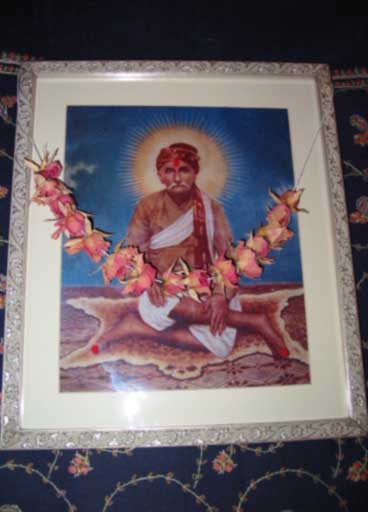
Shri Bhausaheb Maharaj
(c. 1843 – c. 1914)
Bhausaheb Maharaj was the founder of the Inchgiri Sampradaya (a sampradaya is a particular teaching together with its associated practices), and was active in the 19th century and early 20th century. He taught a form of meditation based on the repetition of the divine name–naama yoga. After his intitiation by Shri Nimbargi Maharaj at the early age of 14, his spiritual practice was to meditate regularly on the Divine Name imparted to him during his initiation. He kept this up for twelve hours a day for many many years, always following a strict schedule of meditation, regardless of the exalted spiritual states that he experienced along the way. Later in life, Bhausaheb Maharaj hosted a gathering of his co-disciples and devotees (this was from 1885 to 1903, i.e. for 18 years). In this gathering, the meditation session would start at 6.00 am in the morning and continue until 3.00 Pm in the afternoon. Sacred books, such as Das Bodh, would be read and bhajans sung. (Both of these practices, as well as meditation on the mantra imparted by the Master during initiation, are still part of the lineage today.) What is different is the amount of meditation and level of austerity expected of the aspirant. Bhausaheb Maharaj said the following about his method of spiritual discipline:
“A spiritual aspirant should always meditate on the divine name of God (Naam) and remember the Naam (spiritual name received after initiation). Naam is the only truth and spiritual base for illumination of the soul.”
“Not remembering the name while doing the daily course is nothing but living in an illusion.”
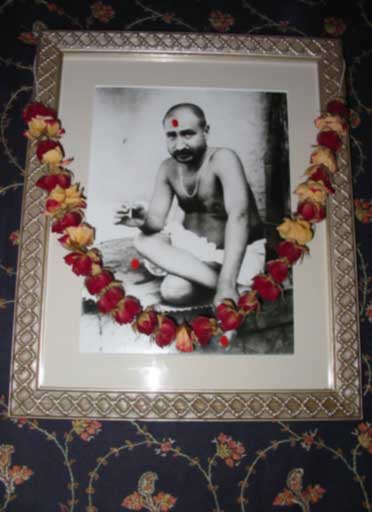
Shri Siddharameshwar Maharaj
1888-1936 (aged 48)
When Bhausaheb Maharaj asked his disciples what it was they wanted, Siddharamappa (the birth name of Siddharameshwar Maharaj) replied “to teach knowledge that has not been taught before and that will never be taught in the future.” He succeeded in this, saying later about his own teaching, “Just think about what glory this is! This is very rare knowledge.” In order to find and formulate this knowledge, Siddharameshar had to go beyond what he was taught by his Master, Shri Bhausaheb Maharaj. He began to understand that meditation was an initial stage and it was necessary to find another way to go further. His co-disciples stuck with meditation because their Master had not indicated anything else, but Siddharameshwar was convinced and set out on his own path. Since his Master had taught him only meditation there was no alternative for him to find out the way to attain the Final Reality. So, ironically, he meditated for nine months without a break. His efforts were finally rewarded when his Master appeared to him in a vision and assured him that he was doing the right thing. Siddharameshwar then began accepting students and teaching them in simple language. He taught from 1926 until his early death in 1936, leaving behind many realized disciples and, unusually, writing several books himself, including the essential practical guide “Master Key to Self-Realization.”

Shri Ranjit Maharaj
4 January 1913-15 November 2000 (aged 87)
This is what Shri Ranjit Maharaj said about the change in approach introduced by his Master:
“There are two ways to realize: the bird’s way or ant’s way. By meditation (or ant’s way) one can realize. The word or name has so much power. The name you were given by your parents has done so many things. Mantra is given by the master, but it is a very long way for the understanding. By chanting or saying the mantra you can go to the final reality. There are only two things: one is reality, the other is illusion. One word only can wipe out illusion.
So one thought [i.e. mantra] from the Master who has realized is sufficient to realize. It is a very lengthy way, that’s the only thing. So my Master found the shortest way, by thinking. By unthinking you have become the smallest creature, and by thinking you can become the greatest of the great, why not? If you don’t have the capacity to understand by thinking, the bird’s way, then you can go by way of meditation. It is the long way and you have to meditate for many hours a day. People say they meditate, but most don’t know how to meditate. They say that God is one and myself is another one, that is the duality. It will never end that way.
So one word is sufficient from the Master. Words can cut words, thoughts can cut thoughts in a fraction of a second. It can take you beyond the words, that is yourself. In meditation you have to eventually submerge your ego, the meditator, and the action of the meditation, and finally yourself. It is a long way, and in this world now people have no time to do that. The world is going so fast now. So my Master found the shortest way.”
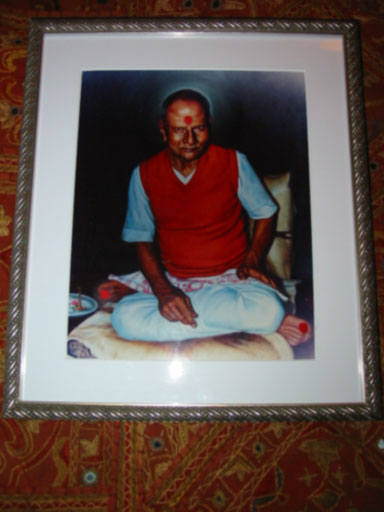
Shri Nisargadatta Maharaj
April 17, 1897-Sept 8, 1981 (age 84)
Nisargadatta Maharaj is the most well known of the masters of this lineage, thanks to the publication of the first book of his talks “I Am That,” which came out in 1973 in an English translation by Maurice Frydman. This is a book that changes lives, and has had that effect on many, due to its direct and uncompromising presentation of non-dual philosophy and practice. It gets right to the point, so to speak.
Nisargadatta himself said of these early talks that they are relatively easy to understand, compared to the later ones (edited by Jean Dunn and published posthumously). In the later talks Nisargadatta makes a clear distinction between two stages in spiritual life: the first, which leads to the attainment of Self-knowledge or Self-realization, and the second, which leads to the disappearance of self or “I” altogether. This distinction is very important and little understood. Not understanding it means that you can mistake Self-knowledge for the Absolute Reality, whereas in fact this is an intermediate stage and, although you have come far and have inner peace or satisfaction, you are not yet at the end of the road. This distinction is also expressed by Nisargadatta’s disciple Shri Ramakant Maharaj in the book that was published of his talks called “Selfless Self,” (Section 4 “Three Stages”), in which he uses the framework of Self-enquiry leading to Self-knowledge followed by Self-realization.
 YOU ARE HE